

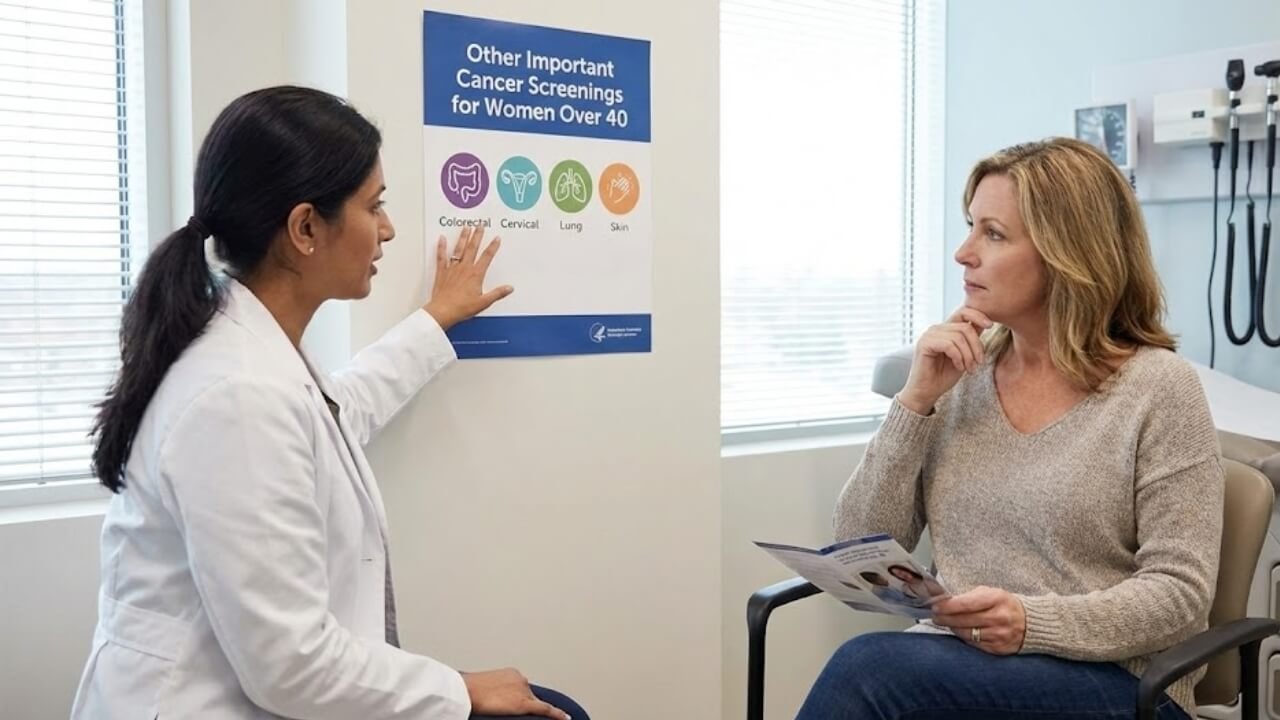
Beyond Breast Cancer: Comprehensive Cancer Prevention
While breast cancer often gets the most attention for women, several other cancers become more common after age 40. Regular screening for cervical, colorectal, skin, and lung cancer (if you smoke) saves lives. This page covers what screenings you need, when to start, and why they matter.
Cervical Cancer Screening
The Good News: Cervical cancer screening is one of medicine’s greatest success stories. Incidence and deaths have decreased by over 50% in the past 40 years due to regular Pap testing.
Understanding Cervical Cancer Risk
Human Papillomavirus (HPV): Nearly all cervical cancers are caused by persistent infection with high-risk HPV types. HPV is extremely common sexually—most people get it at some point, but most infections clear on their own.
Who’s at Risk:
- Any woman with a cervix (even after menopause)
- History of HPV or abnormal Pap tests
- Smoking
- Weakened immune system (HIV, immunosuppressant medications)
- History of STIs
- Multiple sexual partners (or partner with multiple partners)
Screening Guidelines by Age
Ages 21-29:
- Pap test every 3 years
- No HPV testing (too sensitive—detects transient infections that will clear)
Ages 30-65 (Where You Are Now):
- Pap + HPV co-testing every 5 years (preferred)
- OR HPV testing alone every 5 years (acceptable)
- OR Pap test alone every 3 years (acceptable but less preferred)
Co-testing (Pap + HPV) is Best: Most sensitive approach. If both negative, very low risk of cervical cancer for 5 years.
After Age 65:
- Stop screening if:
- Three consecutive negative Pap tests OR
- Two consecutive negative co-tests in past 10 years (most recent within 5 years)
- No history of moderate/severe abnormal cells in past 25 years
- No history of cervical cancer
- Continue screening if:
- History of cervical pre-cancer or cancer
- HIV positive
- Weakened immune system
- DES exposure before birth
- Haven’t been adequately screened previously
After Hysterectomy:
- Stop screening if:
- Cervix was removed
- No history of cervical cancer or pre-cancer
- Continue screening if:
- Hysterectomy was for cancer/pre-cancer
- Cervix was not removed (still have cervix after supracervical hysterectomy)
After HPV Vaccination:
- Follow same screening guidelines
- Vaccine doesn’t protect against all HPV types that cause cancer
- Screening still essential even if vaccinated
What to Expect
The Pap Test:
- During pelvic exam, provider gently scrapes cells from cervix with small brush
- Cells examined under microscope for abnormalities
- Takes seconds, mildly uncomfortable but not painful
- Can be done during regular well-woman exam
HPV Testing:
- Uses same cell sample as Pap (no additional discomfort)
- Tests for high-risk HPV types that cause cancer
Understanding Results
Pap Results:
- Normal/Negative: Continue routine screening
- ASC-US (atypical squamous cells of undetermined significance): Unclear significance—HPV test determines next steps
- LSIL (low-grade squamous intraepithelial lesion): Mild abnormalities—colposcopy usually recommended
- HSIL (high-grade squamous intraepithelial lesion): Moderate to severe abnormalities—colposcopy and treatment needed
- AGC (atypical glandular cells): Colposcopy needed
HPV Results:
- Negative: No high-risk HPV detected
- Positive: High-risk HPV detected—next steps depend on Pap result and age
If Abnormal:
- Usually colposcopy (magnified examination of cervix)
- Biopsy if abnormal areas seen
- Treatment if pre-cancer confirmed (LEEP, cryotherapy, cone biopsy)
- Most abnormalities are pre-cancer (not cancer) and highly treatable
Key Points
Don’t Skip Just Because You’re Postmenopausal:
- Risk doesn’t disappear after menopause
- HPV infections acquired years ago can persist
- Cervical cancer can occur at any age
- Continue screening until 65 if you’ve been screening regularly
Sexual History Doesn’t Matter Now:
- Even if you’ve had one lifetime partner or haven’t been sexually active in years, continue screening
- HPV can remain dormant for decades
- Past exposure still creates risk
After 65, You’re Likely Done: If you’ve been screened regularly with normal results, you can stop at 65. But if you had abnormal results or haven’t been screened regularly, continue.
Colorectal Cancer Screening
Critical for This Age Group: Colorectal cancer is the third most common cancer and second leading cause of cancer death in women. Screening saves lives by detecting cancer early or preventing it entirely by removing precancerous polyps.
When to Start
Average Risk:
- Start at age 45 (updated from age 50)
- Earlier if symptoms or risk factors
High Risk:
- Start earlier (as young as age 20-25 for some genetic syndromes)
- Screen more frequently
High-Risk Factors:
- Personal history of colorectal cancer or polyps
- Inflammatory bowel disease (Crohn’s disease, ulcerative colitis)
- Family history of colorectal cancer (especially first-degree relative before age 60)
- Genetic syndromes (Lynch syndrome, FAP)
- Personal history of radiation to abdomen or pelvis
Screening Options
Colonoscopy (Gold Standard):
- Frequency: Every 10 years (if normal)
- Views entire colon with camera on flexible tube
- Polyps removed during procedure (cancer prevention!)
- Requires bowel prep (clear liquids day before, laxatives)
- Done under sedation (you won’t remember anything)
- Small risks: bleeding, perforation (very rare)
Advantages:
- Most accurate
- Both diagnosis and treatment (polyps removed)
- Less frequent than other tests
FIT (Fecal Immunochemical Test):
- Frequency: Annually
- At-home stool test detects hidden blood
- No prep, no diet restrictions
- If positive, need colonoscopy
Advantages:
- Easy, done at home
- No prep or sedation
- Inexpensive
Disadvantages:
- Must do every year
- Only detects some cancers/polyps
- High false positive rate
- Doesn’t prevent cancer (doesn’t remove polyps)
FIT-DNA (Cologuard):
- Frequency: Every 3 years
- At-home stool test detects blood and DNA changes
- No prep required
- If positive, need colonoscopy
Advantages:
- More sensitive than FIT alone
- Done at home
- Every 3 years instead of annually
Disadvantages:
- Higher false positive rate than FIT
- More expensive
- Still need colonoscopy if positive
CT Colonography (Virtual Colonoscopy):
- Frequency: Every 5 years
- CT scan of colon
- Requires bowel prep (but no sedation)
- If polyps found, need colonoscopy for removal
Advantages:
- Less invasive than colonoscopy
- No sedation
Disadvantages:
- Radiation exposure
- Can’t remove polyps during procedure
- May find incidental findings in other organs requiring follow-up
- Not widely available
- May not be covered by insurance
Flexible Sigmoidoscopy:
- Frequency: Every 5 years (or every 10 years with annual FIT)
- Views only lower third of colon
- Minimal prep
- No sedation usually
Rarely Used Anymore: Colonoscopy is superior.
Which Test Should You Choose?
Best Overall: Colonoscopy
- Most comprehensive
- Prevents cancer by removing polyps
- Less frequent (every 10 years)
- Gold standard
If You Really Can’t/Won’t Do Colonoscopy:
- Annual FIT is second best
- The most important thing is that you DO some form of screening
Colorectal Cancer Symptoms
Don’t wait for symptoms to get screened (screening finds cancer before symptoms), but see your doctor immediately if you experience:
- Rectal bleeding or blood in stool
- Change in bowel habits lasting more than a few days (diarrhea, constipation, narrow stools)
- Feeling that bowel doesn’t empty completely
- Abdominal pain, cramping, bloating
- Unexplained weight loss
- Persistent fatigue
Why Screening Matters
Prevention: Colonoscopy can actually prevent cancer by removing polyps before they turn cancerous. No other cancer screening does this.
Early Detection: If cancer is found, detecting it early means:
- Localized cancer: 90% 5-year survival
- Regional spread: 72% 5-year survival
- Distant spread: 14% 5-year survival
Colonoscopy Saves Lives: Studies show colonoscopy reduces colorectal cancer deaths by 60-70%.
Don’t Skip It: Many people avoid colonoscopy due to fear of prep or procedure. The prep is the worst part (not fun but manageable), and you won’t remember the procedure itself. A few hours of discomfort is worth preventing a deadly cancer.
Skin Cancer Screening
Why It Matters: Skin cancer is the most common cancer. Most are highly treatable if caught early, but melanoma (most dangerous type) can be deadly.
Risk Factors
- Fair skin, light hair, light eyes
- History of sunburns (especially blistering sunburns in childhood)
- Extensive sun exposure over lifetime
- Tanning bed use
- Many moles (over 50)
- Atypical moles
- Personal or family history of skin cancer
- Weakened immune system
Types of Skin Cancer
Basal Cell Carcinoma:
- Most common (80% of skin cancers)
- Rarely spreads
- Highly treatable
Squamous Cell Carcinoma:
- Second most common
- Can spread if untreated
- Highly treatable when caught early
Melanoma:
- Less common but most dangerous
- Can spread quickly
- Early detection critical (98% 5-year survival if caught early; drops dramatically if spread)
Screening Recommendations
Skin Self-Exams:
- Monthly self-checks recommended
- Check entire body including scalp, between toes, soles of feet, genitals, under breasts
- Use full-length and hand mirrors
- Check for new spots, changing spots, or sores that don’t heal
Clinical Skin Exams:
- Annual full-body exam by dermatologist if high-risk
- Every 1-3 years for average risk
- During annual physical, primary care provider should check visible skin
Warning Signs (ABCDE Rule for Melanoma)
A – Asymmetry: One half doesn’t match the other half
B – Border: Irregular, ragged, notched, or blurred edges
C – Color: Multiple colors or uneven distribution of color (brown, black, tan, red, white, blue)
D – Diameter: Larger than 6mm (pencil eraser), though melanomas can be smaller
E – Evolving: Changing in size, shape, color, elevation, or new symptoms (itching, bleeding)
Also Watch For:
- Sore that doesn’t heal
- New growth
- Spot that looks different from your other moles (“ugly duckling”)
- Mole that itches, bleeds, or hurts
If You Find Something Concerning
- Don’t panic (most skin abnormalities are benign)
- See dermatologist promptly
- Biopsy determines if cancerous
- Treatment usually simple excision if caught early
Prevention
Sun Protection:
- Sunscreen SPF 30+ daily (even cloudy days, even winter)
- Reapply every 2 hours if outside
- Protective clothing (long sleeves, wide-brimmed hat)
- Avoid sun during peak hours (10am-4pm)
- Seek shade
- Never use tanning beds (classified as carcinogenic)
It’s Never Too Late: Even though damage is cumulative, starting sun protection now reduces future risk. Previous sun exposure can’t be undone, but you can prevent additional damage.
Lung Cancer Screening
Only for High-Risk Individuals: Not everyone needs lung cancer screening—only those at high risk from smoking.
Who Should Be Screened
Criteria:
- Age 50-80
- Current smoker or quit within past 15 years
- 20+ pack-year smoking history (packs per day × years smoked—e.g., 1 pack daily for 20 years, or 2 packs daily for 10 years)
Screening Method
Low-Dose CT Scan:
- Frequency: Annually
- Quick CT scan of chest
- Low radiation dose (much less than regular CT)
- No contrast dye
- Takes 10 minutes
- No preparation needed
Benefits:
- Reduces lung cancer deaths by 20% in high-risk smokers
- Finds cancer at earlier, more treatable stage
Downsides:
- Many false positives (nodules found that aren’t cancer)
- May lead to unnecessary biopsies
- Anxiety from false alarms
- Small radiation exposure (cumulative over years of annual screening)
- Only useful for current/recent smokers—doesn’t help those who quit long ago
Most Important: Quit Smoking
Screening Is NOT a Substitute for Quitting:
- Quitting smoking reduces lung cancer risk significantly
- Benefits begin immediately after quitting
- Risk continues to decrease over time (though never returns to never-smoker level)
- Many resources available: medications (varenicline, bupropion, nicotine replacement), counseling, quitlines, support groups
It’s Never Too Late: Even if you’ve smoked for decades, quitting now improves your health and reduces risk of lung cancer, heart disease, stroke, COPD, and other diseases.
Other Screenings to Remember
Beyond Cancer Screening:
Blood Pressure:
- At least annually
- More frequently if elevated
- Hypertension increases after menopause
Cholesterol:
- Every 5 years (more frequently if abnormal or heart disease risk factors)
Diabetes:
- Every 3 years starting at 45 (earlier if overweight/risk factors)
- Annual screening if prediabetes
Bone Density (DEXA scan):
- All women at age 65
- Younger if risk factors (see bone health pages)
Thyroid:
- No routine screening recommended
- Test if symptoms
Vision and Hearing:
- Regular exams as needed
- More important as you age
Creating Your Screening Schedule
Your Age 40-49 Checklist:
- ✓ Annual mammogram
- ✓ Pap test every 3 years OR Pap + HPV every 5 years
- ✓ Start colorectal screening at 45
- ✓ Annual skin check (self-exam + dermatologist if high-risk)
- ✓ Lung CT if high-risk smoker (starting age 50)
Your Age 50-64 Checklist:
- ✓ Annual mammogram
- ✓ Pap + HPV every 5 years
- ✓ Colonoscopy every 10 years (or annual FIT)
- ✓ Annual skin checks
- ✓ Lung CT annually if high-risk smoker
Age 65+ Checklist:
- ✓ Annual mammogram (if healthy)
- ✓ Stop Pap testing (if previously screened regularly)
- ✓ Continue colonoscopy every 10 years until age 75
- ✓ Continue skin checks
- ✓ DEXA scan for bone density
- ✓ Continue lung screening if high-risk smoker through age 80
Set Reminders:
- Use phone calendar with annual reminders
- Schedule next appointment before leaving current one
- Pair screenings with birthday month or January (fresh start)
Overcoming Barriers
“I Feel Fine, Why Do I Need Screening?” Because cancer has no symptoms in early stages. That’s the entire point of screening—finding it before symptoms appear.
“I’m Too Busy” Screenings take minimal time and could save your life. Prioritize your health like you would anything else important.
“I’m Scared of What They’ll Find” Finding cancer early is much better than finding it late when symptoms appear. Early detection dramatically improves outcomes.
“It’s Too Expensive” Most insurance plans cover preventive cancer screenings with no copay. Free/low-cost programs available for uninsured.
“The Prep Is Terrible” (Colonoscopy) The prep is unpleasant but brief. A few hours of discomfort is worth preventing a cancer that could kill you.
The Bottom Line
Screening Saves Lives:
- Cancer screening is one of the most effective tools in medicine
- Finds cancer early when most treatable
- Some screenings (colonoscopy) actually prevent cancer
- Worth the time, minor discomfort, and effort
What You Need:
- Breast: Annual mammogram starting 40
- Cervical: Pap + HPV every 5 years through age 65
- Colorectal: Starting age 45, colonoscopy every 10 years (or annual FIT)
- Skin: Monthly self-checks, annual dermatologist if high-risk
- Lung: Annual low-dose CT if high-risk smoker age 50-80
Make Screening a Priority: Your health is worth it. Your family needs you. Early detection saves lives. Schedule your screenings today.