

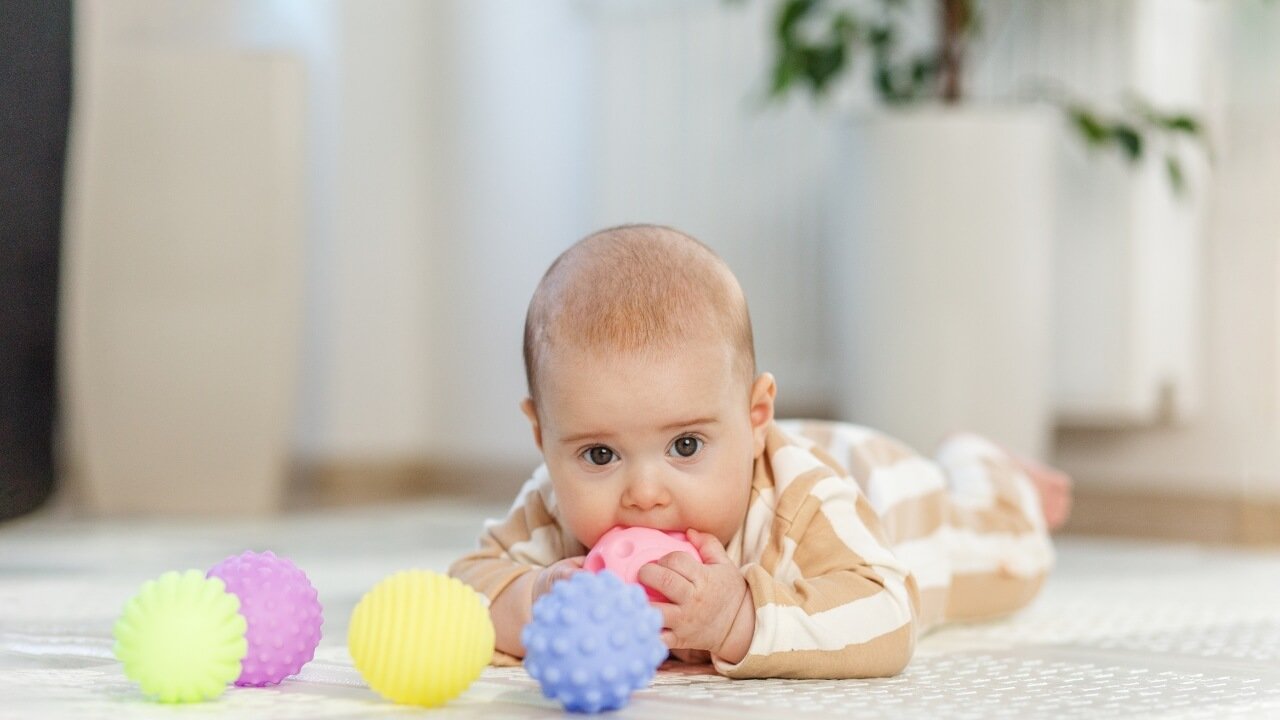
Your Social, Interactive Baby
Between 3 and 6 months, your baby transforms from a relatively passive observer into an active, social participant in family life. Expect delightful laughter, intentional reaching and grasping, rolling over, and increasingly clear personality traits. This is often when parenting becomes significantly more fun and interactive!
Physical Development
Rolling Over (Big Milestone!):
- 3-4 months: May begin rolling from tummy to back (easier direction)
- 4-5 months: Rolling from back to tummy (requires more strength and coordination)
- 5-6 months: Rolling both directions confidently, may use rolling to move across the room
Safety Note: Once baby can roll, never leave them unattended on elevated surfaces (changing table, bed, couch).
Sitting Development:
- 3-4 months: Sits with significant support; head wobbles if support is removed
- 4-5 months: Sits with support (tripod position—leans forward on hands); good head control
- 5-6 months: May sit independently for brief periods; still topples over frequently
- 6 months: Some babies sit independently, others still need support (both normal)
Hand and Grasp Development:
3-4 Months:
- Batting at objects becomes more accurate
- Reaches for objects with both hands
- Brings objects to mouth (everything goes in the mouth!)
- Holds rattle or toy placed in hand
4-5 Months:
- Intentional reaching with one hand
- Grasps objects using entire hand (palmar grasp)
- Transfers objects from hand to hand
- Shakes toys to make noise
5-6 Months:
- Reaches and grasps smoothly
- Uses raking motion to pull small objects closer
- Beginning to use thumb and fingers separately (preparing for pincer grasp)
- Holds bottle (but still needs supervision)
- Explores objects by touching, shaking, banging, and mouthing
General Motor Skills:
- Leg strength: Bears weight on legs when held standing; bounces enthusiastically
- Pushing up: During tummy time, pushes up on hands with arms extended
- Active movement: Lots of kicking, wiggling, and rocking back and forth
- Some babies: May begin scooting backwards or pivoting in circles
Cognitive Development
Vision:
- Color vision is fully mature
- Can see across the room clearly
- Tracks moving objects smoothly and quickly
- Depth perception developing
- Recognizes familiar faces across a room
- Studies small objects carefully
Cause and Effect Understanding:
- Drops object to watch it fall (over and over!)
- Shakes rattle to hear sound
- Kicks legs to make mobile move
- Understands actions have results—will repeat actions to get desired outcome
Object Exploration:
- Explores objects using all senses—looking, touching, shaking, banging, mouthing
- Reaches for objects they want
- Looks for dropped objects (beginning to understand objects still exist when out of sight)
- May show preference for certain toys
Memory Development:
- Remembers familiar faces
- Recognizes favorite toys
- Shows anticipation (gets excited when sees bottle, bath, or favorite activity)
- May become anxious around strangers (beginning of stranger awareness)
Social and Emotional Development
The Laughing Baby:
- 4 months: Real laughter emerges (one of the best sounds ever!)
- Laughs at sounds, faces, and actions (peek-a-boo, raspberries, funny noises)
- Laughs when tickled gently
- Increasingly social and interactive
Social Smiles and Interaction:
- Smiles readily at familiar people
- May smile at strangers initially (stranger anxiety comes later)
- Engages in “conversations” with you through smiles, coos, and babbles
- Responds to your emotional tone (smiles if you smile, concerned if you seem upset)
- Enjoys social games (peek-a-boo, pat-a-cake)
Attachment:
- Clear preference for primary caregivers
- May show early signs of separation anxiety
- Calms more quickly for familiar people
- Secure attachment supports confident exploration
Personality Emerging:
- Individual temperament becomes clearer
- Some babies are active and energetic; others are calm and observant
- Some are social and outgoing; others are more cautious
- Different babies have different sensitivities to noise, activity, and stimulation
Communication and Language Development
Babbling Begins:
3-4 Months:
- Cooing continues and becomes more elaborate
- Experiments with volume (loud squeals and quiet murmurs)
- Makes vowel sounds (“aaah,” “ooooh”)
4-5 Months:
- True babbling begins—consonant-vowel combinations (“ba,” “da,” “ma”)
- Practices sounds repeatedly
- Imitates sounds you make
- “Talks” to toys and self
5-6 Months:
- More complex babbling with multiple syllables (“ba-ba-ba,” “da-da-da”)
- Changes pitch and tone (sounds like conversation even though not using words)
- Responds to name by looking toward person calling
- Understands tone of voice (knows when you’re happy, upset, or excited)
Receptive Language (Understanding):
- Responds to own name
- Recognizes words for familiar objects and people (“bottle,” “daddy”)
- Understands “no” by tone (though won’t always obey!)
- Responds to familiar routines and songs
Communication:
- Uses different cries for different needs
- Makes sounds to get attention
- Reaches arms to be picked up
- Turns away when done with activity
Sleep Development
Longer Nighttime Sleep:
- Many (but not all) babies sleep 6-8 hour stretches at night by 4-6 months
- Some babies still wake to feed—this is normal too
- Total sleep: 12-15 hours per day (including naps)
Nap Pattern Emerging:
- Transitioning from 3-4 short naps to 2-3 longer naps
- Morning and afternoon naps become more predictable
- Some babies still take 3 naps; others transition to 2
Sleep Associations:
- May develop sleep associations (nursing, rocking, pacifier)
- Some babies can self-soothe to sleep; others need help
- Sleep training methods can begin around 4-6 months if desired (but not required)
4-Month Sleep Regression: Many babies experience sleep disruption around 4 months as sleep patterns mature. Temporary but exhausting! Stay consistent with routines; it passes.
Feeding Development
Breastfeeding/Bottle Feeding:
- Efficient feeders—may finish nursing/bottle in 10-15 minutes
- Easily distracted by surroundings (may pull off to look around)
- Some babies become fussier at breast as they become more aware
- May show interest in what you’re eating
Introduction to Solid Foods:
- Most babies: Ready for solids around 6 months
- Some babies: May be ready as early as 4-5 months if showing all readiness signs
Signs of Readiness for Solids:
- Can sit with support and has good head control
- Lost tongue-thrust reflex (doesn’t automatically push food out with tongue)
- Shows interest in food (reaches for your food, watches you eat)
- Opens mouth when food approaches
- Can move food to back of mouth and swallow
Not Ready Based On:
- Age alone
- Waking at night (doesn’t mean baby needs solids)
- Wanting to feed more frequently (growth spurt, not hunger)
Starting Solids (If Ready Around 6 Months): See our dedicated solid foods page for detailed guidance. Brief overview:
- Breast milk or formula remains primary nutrition until 12 months
- Solids are for practice and exploration initially
- Start with iron-rich foods (iron-fortified infant cereal, pureed meat, or beans)
- One new food at a time, waiting 3-5 days before introducing another
- No honey before 12 months (risk of botulism)
Teething May Begin
When Teething Starts:
- Average: First tooth around 6-7 months
- Range: 3 months to 12 months (wide variation is normal)
- Usually bottom two front teeth appear first
Teething Symptoms:
- Drooling (increases significantly)
- Chewing on everything
- Gum swelling and sensitivity
- Irritability and fussiness
- Disrupted sleep
- May refuse food or want to nurse more
What Doesn’t Cause Teething:
- High fever (over 101°F)
- Diarrhea
- Significant illness (If baby has these symptoms, see doctor—it’s not just teething)
Teething Relief:
- Cold washcloth to chew on
- Chilled (not frozen) teething ring
- Gentle gum massage with clean finger
- Teething toys (safe for mouthing)
- Acetaminophen or ibuprofen if baby seems very uncomfortable (ask pediatrician about dosing)
Age-Appropriate Activities and Play
Interactive Games:
- Peek-a-boo: Teaches object permanence and is endlessly entertaining
- Pat-a-cake: Hand coordination and rhythm
- This Little Piggy: Tactile play and anticipation
- Simple songs with actions: Row Row Row Your Boat, Itsy Bitsy Spider
Physical Play:
- Continue tummy time (baby may now push up to hands and knees)
- Supported sitting play
- Gentle bouncing while standing on your lap
- Rolling games (placing toy to side to encourage rolling)
- “Baby exercises” (bicycle legs, gentle stretches)
Exploration and Learning:
- Let baby explore safe household objects (wooden spoons, plastic containers, soft cloths)
- Play with cause-and-effect toys (activity centers, toys that make sounds)
- Sensory exploration (different textures, temperatures, sounds)
- Mirror play (babies love looking at themselves)
Reading:
- Board books with simple, bright pictures
- Books with textures to touch
- Read expressively with different voices and sounds
- Let baby hold, mouth, and turn pages
Best Toys:
- Soft blocks
- Rattles and shakers
- Teething toys
- Activity mats and centers
- Soft balls
- Board books
- Toys with different textures
- Toys that make interesting sounds
- Unbreakable mirror
Most Important: Your interaction matters more than toys. Talking, singing, playing, and cuddling support development best.
Safety Considerations
Now That Baby is More Mobile:
- Begin baby-proofing (secure furniture, cover outlets, remove choking hazards)
- Everything goes in mouth—keep small objects out of reach
- Never leave baby unattended on elevated surfaces
- Ensure safe sleep environment always
- Keep cords and strings away from baby
- Watch for items baby could reach and pull down
Choking Hazards: Anything smaller than a toilet paper roll can be a choking hazard. Watch carefully.
Developmental Red Flags
Contact pediatrician if by 6 months baby:
- Doesn’t reach for objects
- Shows no affection for caregivers
- Doesn’t respond to sounds
- Has difficulty getting things to mouth
- Doesn’t make vowel sounds (“ah,” “eh,” “oh”)
- Doesn’t roll in either direction by 6 months
- Seems very stiff or very floppy
- Can’t support head well
- Doesn’t smile at people
- One eye or both eyes consistently turn in or out
Also contact doctor if:
- Baby loses skills they previously had
- Your instinct says something isn’t right
Supporting Development
What Baby Needs:
- Responsive care to needs
- Plenty of face-to-face interaction
- Opportunities for safe exploration
- Tummy time and physical play
- Variety of safe objects to explore
- Reading and singing
- Loving, predictable care
What Baby Doesn’t Need:
- Educational videos or screen time (not recommended before 18-24 months)
- Expensive developmental programs
- Structured classes
- Pressure to reach milestones early
- Constant stimulation (babies need quiet time too)
Looking Ahead
By 6 months, your baby is dramatically different from that tiny newborn—sitting (or close to it), grasping and exploring objects, laughing at your jokes, and showing clear preferences and personality. The next six months bring even more exciting developments: crawling, first words, and increasing independence. Enjoy this delightful interactive stage!