

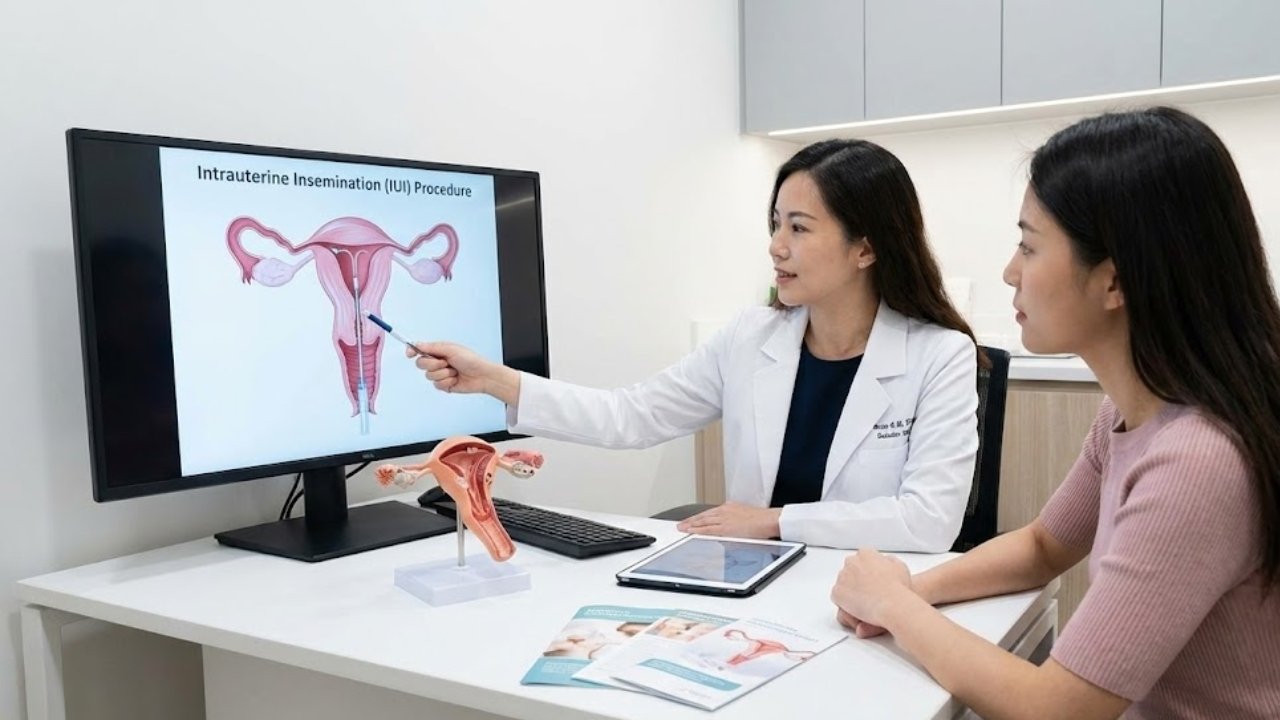
IUI is often the first fertility treatment tried. It’s less invasive and less expensive than IVF.
What Is IUI?
Intrauterine Insemination (IUI):
- Sperm placed directly into uterus during ovulation
- Bypasses cervix and vagina
- Gives sperm “head start” closer to egg
- Timed precisely with ovulation
- Quick, simple procedure
Also called:
- Artificial insemination
- Intrauterine insemination
How it helps:
- Increases number of sperm reaching fallopian tubes
- Places best-quality sperm closer to egg
- Overcomes cervical mucus issues
- Concentrates motile sperm
Best Candidates for IUI
Who Benefits Most
Unexplained infertility:
- All tests normal
- No identified cause
- Timing and number optimization
Mild male factor:
- Slightly low sperm count (at least 5-10 million after processing)
- Reduced motility (but some good swimmers)
- Morphology issues
Cervical mucus problems:
- Hostile cervical environment
- Antibodies against sperm
- Insufficient or too thick mucus
Mild endometriosis:
- Stage I or II
- After surgical treatment
- No tubal damage
Ovulation problems:
- Irregular ovulation
- Combined with ovulation medications
- PCOS with medication
Sexual dysfunction:
- Erectile dysfunction
- Ejaculation problems
- Painful intercourse
- Timing difficulties
Single women or same-sex couples:
- Using donor sperm
- Excellent success rates
Who Should Skip to IVF
IUI not appropriate if:
- Blocked or damaged fallopian tubes (need at least one open tube!)
- Severe male factor (count under 5 million after processing)
- Advanced maternal age (over 40)
- Severe endometriosis
- Multiple failed IUI cycles (usually after 3-6)
- Low ovarian reserve
HSG test required before IUI to confirm open tubes.
The IUI Process: Step by Step
Before Starting
Required tests:
- HSG test (Hysterosalpingogram) – MUST confirm at least one tube is open
- Hormone blood work
- Semen analysis
- Infectious disease screening
Without open tubes, IUI cannot work!
Step 1: Medications (Day 1-11)
Ovulation-inducing medications:
- Started Day 2-3 of your cycle
- Taken for approximately 11 days
Common medications:
- Clomiphene Citrate (Clomid) – oral pills
- Letrozole (Femara) – oral pills, especially for PCOS
- Gonadotropins (FSH injections) – more aggressive, multiple eggs
Goal:
- Stimulate 1-3 mature follicles
- More follicles = higher chance
- Too many follicles = cycle may be canceled (high-order multiple risk)
Step 2: Monitoring (Throughout Cycle)
Frequent appointments during stimulation:
Ultrasounds:
- Track follicle growth
- Measure size of each follicle
- Count how many are developing
- Ensure not too many
Blood tests:
- Estradiol (estrogen) levels
- Confirms follicle maturity
- Helps time trigger shot
Typical monitoring:
- Every 2-3 days during stimulation
- More frequent near ovulation
- Usually 2-4 monitoring visits per cycle
Step 3: Trigger Shot
When follicles are mature (18-20mm):
- hCG injection given
- “Triggers” final egg maturation
- Ovulation occurs 36 hours later
Timing is critical:
- Must be exact time as instructed
- Sets schedule for IUI
- Usually given at night
Step 4: Sperm Preparation
Day of IUI (Day 13-14 typically):
Partner provides sample:
- At clinic or brought from home (within 1 hour)
- Collected through masturbation
- 2-5 day abstinence period optimal
Lab “washes” sperm (1-2 hours):
- Separates sperm from seminal fluid
- Concentrates most motile sperm
- Removes dead sperm and debris
- Final sample has highest quality swimmers
Total motile sperm count after washing:
- Over 10 million: Good prognosis
- 5-10 million: Fair prognosis
- Under 5 million: Poor prognosis (may recommend IVF instead)
Donor sperm already prepared and frozen.
Step 5: IUI Procedure (Days 13 & 14)
Two inseminations typically performed:
- Day 13 and Day 14 after trigger
- Or Day 14 and Day 15
- Timing based on your cycle
- Increases chance of catching ovulation
The procedure (5-10 minutes):
- You lie on exam table (like Pap smear)
- Speculum inserted
- Cervix cleaned
- Very thin catheter inserted through cervix into uterus
- Prepared sperm injected
- Catheter removed
- Rest 10-15 minutes
Pain level:
- Usually minimal discomfort
- Like mild period cramps
- Brief catheter insertion sensation
- Most women tolerate well
After procedure:
- Go about normal day
- No bed rest needed
- Can work, exercise lightly
- Intercourse okay (and encouraged!)
Step 6: Luteal Phase Support (Sometimes)
Progesterone supplementation may be prescribed:
- Vaginal suppositories or oral capsules
- Supports implantation
- Started day after IUI
- Continued until pregnancy test
Not always needed – depends on protocol and doctor preference.
Step 7: The Two-Week Wait
14 days after IUI:
- Waiting to test
- Most stressful part
- Symptoms or no symptoms both normal
- Don’t test too early!
Blood pregnancy test:
- Done at clinic
- Approximately 14 days post-IUI
- More accurate than home test
Success Rates
Per Cycle Success Rates
Varies widely based on factors:
By age (using partner sperm):
- Under 35: 10-15% per cycle
- 35-40: 8-10% per cycle
- Over 40: 2-5% per cycle
By diagnosis:
- Unexplained: 10-15%
- Mild male factor: 8-12%
- Ovulation disorders: 12-15%
- Endometriosis: 5-10%
With donor sperm (younger donors):
- Higher success rates
- 15-20% per cycle
Cumulative Success Rates
Success increases with multiple cycles:
- After 3 cycles: 30-40% cumulative
- After 6 cycles: 40-50% cumulative
Most pregnancies occur within first 3-4 cycles.
Factors Affecting Success
Better success with:
- Younger age
- No tubal damage
- Good sperm count after processing
- Multiple mature follicles (2-3)
- Unexplained infertility
- Timing of insemination
Lower success with:
- Age over 37
- Severe male factor
- Endometriosis
- Only one follicle
- Previous failed cycles
How Many Cycles to Try?
Typical Recommendations
3-6 IUI cycles:
- Most doctors recommend 3-4 cycles minimum
- Up to 6 cycles before moving to IVF
- Diminishing returns after 4-6 attempts
If not pregnant after 3-4 cycles:
- Reassess treatment plan
- Consider IVF
- Additional testing
- Change medications or protocol
When to Move On Sooner
Consider IVF after 1-2 failed IUIs if:
- Age over 38-40
- Very low ovarian reserve
- Time is critical
- Male factor worsening
- Financial considerations (IVF may be more cost-effective)
Discuss with your doctor based on your specific situation.
Risks and Side Effects
From Medications
Ovulation medications cause:
- Bloating
- Mood swings
- Hot flashes
- Breast tenderness
- Headaches
Rare but serious:
- Ovarian hyperstimulation syndrome (OHSS)
- Usually with injectable medications
- Severe bloating, pain, fluid accumulation
Multiple Pregnancy Risk
IUI increases chance of twins or more:
- Stimulating multiple eggs
- Risk: 10-20% twins, 1-3% triplets
- Higher with injectable medications
- Cycle canceled if too many follicles (usually >4)
Multiple pregnancy has risks:
- Preterm birth
- Pregnancy complications
- Higher c-section rate
Doctor monitors to minimize risk while optimizing success.
From Procedure Itself
IUI procedure risks (very rare):
- Infection (less than 1%)
- Spotting (common, not concerning)
- Cramping (common, normal)
- Allergic reaction to washing medium (extremely rare)
Very safe procedure overall.
What to Expect Emotionally
The Roller Coaster
Each cycle brings:
- Hope at the start
- Anxiety during wait
- Anticipation approaching test
- Joy if positive
- Crushing disappointment if negative
This emotional cycle is exhausting.
Coping Strategies
Take care of yourself:
- One cycle at a time mindset
- Plan distractions during two-week wait
- Support system activated
- Self-care priorities
- Allow yourself to grieve failures
When to Take a Break
It’s okay to pause:
- After multiple failures
- Financial strain
- Emotional exhaustion
- Need to regroup
- Physical break from medications
Taking a break doesn’t mean giving up.
Improving Your Chances
Before IUI
Optimize your health:
- Maintain healthy weight
- Take prenatal vitamins
- Folic acid daily
- Stop smoking
- Limit alcohol
- Reduce stress
During Treatment
Support your cycle:
- Take medications exactly as prescribed
- Attend all monitoring appointments
- Follow trigger shot timing precisely
- Stay hydrated
- Get adequate rest
After IUI
No special restrictions:
- Normal activities okay
- No bed rest needed (doesn’t help)
- Sex is fine (may even help!)
- No specific diet required
- Avoid excessive exercise
Implantation happens 6-12 days after IUI – what you do immediately after doesn’t affect it.
Questions to Ask Your Doctor
Before starting IUI:
✓ What are my chances with IUI vs. IVF?
✓ What medication protocol do you recommend?
✓ How many follicles are we aiming for?
✓ What if I have too many follicles?
✓ How many cycles should we try before moving to IVF?
✓ When will I know if it worked?
✓ What’s the plan if this doesn’t work?
Remember
IUI is a simple, relatively low-tech intervention that helps many couples conceive. While success rates are modest per cycle, cumulative rates over multiple cycles are encouraging.
IUI is a reasonable first step for many couples.
Success rates are modest but real. Many babies born through IUI.
If it doesn’t work, you haven’t wasted time – you’ve gained information.
IUI often leads to IVF, which has higher success rates. Each step is progress.
Stay hopeful but realistic. Be patient with the process and yourself.