

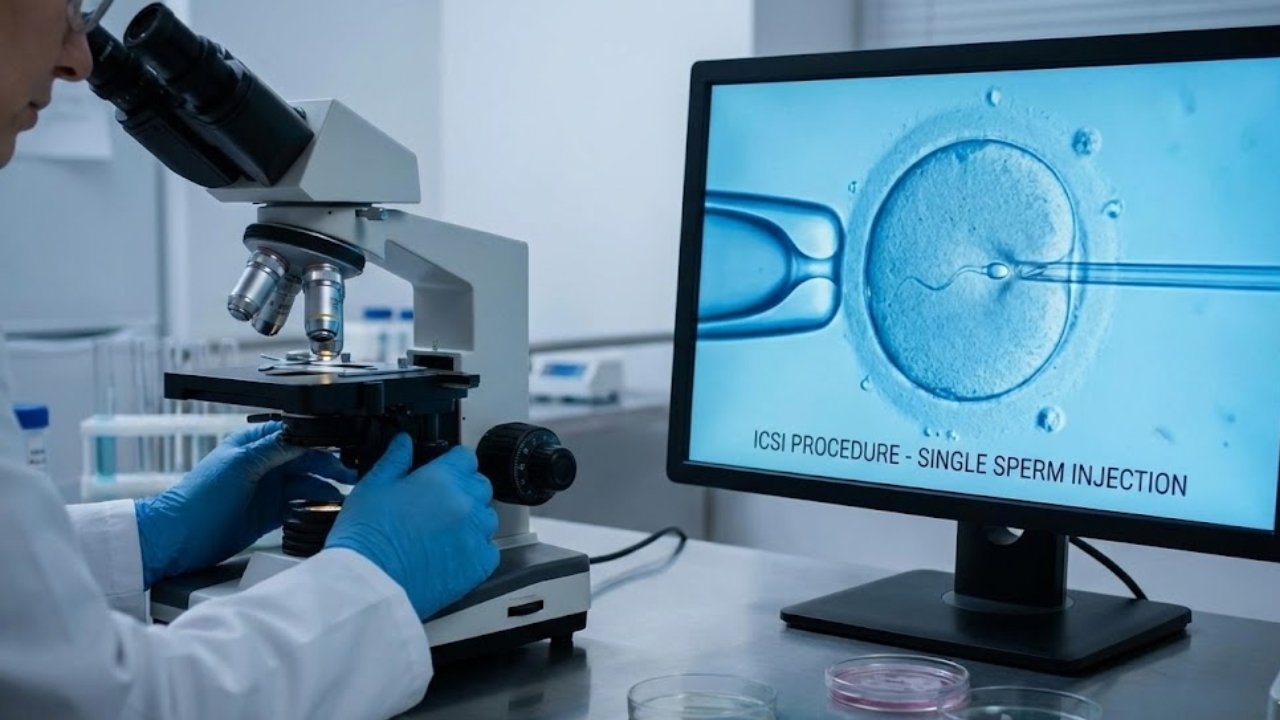
ICSI allows fertilization even with very low sperm counts – a revolutionary advancement for male factor infertility.
What Is ICSI?
Intracytoplasmic Sperm Injection (ICSI):
- Single sperm injected directly into egg
- Done in laboratory during IVF cycle
- Performed by skilled embryologist
- Uses microscopic equipment
- Bypasses natural fertilization barriers
Pronounced “ICK-see”
How it differs from standard IVF:
- Standard IVF: Sperm and eggs mixed together in dish, sperm penetrates egg naturally
- ICSI: One sperm selected and injected into each mature egg
ICSI revolutionized male infertility treatment – even one viable sperm can create pregnancy.
When ICSI Is Recommended
Male Factor Infertility
Low sperm count (oligozoospermia):
- Less than 15 million sperm/mL
- Very few sperm to work with
Poor motility (asthenozoospermia):
- Less than 40% moving forward
- Sperm can’t reach or penetrate egg
Abnormal morphology (teratozoospermia):
- Less than 4% normally shaped
- Affects ability to penetrate egg
Zero sperm in ejaculate (azoospermia):
- Sperm surgically retrieved from testicles or epididymis
- TESE (testicular sperm extraction) or PESA (percutaneous epididymal sperm aspiration)
- ICSI required – too few sperm for standard IVF
High anti-sperm antibodies:
- Immune system attacking sperm
- Prevents natural fertilization
Previous Fertilization Failure
No or low fertilization in past IVF:
- Even with normal sperm parameters
- Sperm can’t penetrate egg for unknown reasons
- ICSI bypasses this problem
Frozen or Surgically Retrieved Sperm
Using frozen sperm:
- May have reduced motility after thawing
- ICSI ensures fertilization
Surgically retrieved sperm:
- From testicular biopsy
- Limited quantity
- Motility often low
- ICSI essential
Other Situations
Preimplantation genetic testing (PGT):
- Avoiding external sperm contaminating biopsy
- Only ICSI-fertilized embryos used
Low number of eggs:
- Maximizes fertilization chance with few eggs
Unexplained infertility with failed IUIs:
- Sometimes used proactively
Using frozen eggs:
- Eggs more fragile after freezing
- ICSI avoids mechanical damage from multiple sperm
The ICSI Procedure
Timing
Day of egg retrieval:
- Partner provides fresh sperm sample OR
- Frozen sperm thawed OR
- Surgically retrieved sperm used
Within hours of egg retrieval:
- Performed same day
- Eggs must be mature
- You’re recovering at home while this happens
In the Laboratory
Sperm preparation:
- Sperm sample processed and washed
- Best-quality sperm selected
- Sperm immobilized (tail crushed) to prevent damage
Egg preparation:
- Cumulus cells (surrounding layer) removed from eggs
- Only mature eggs (Metaphase II) can be injected
- Eggs assessed for quality
The injection (per egg):
- Egg held in place with holding pipette
- Single sperm drawn into injection pipette (ultra-thin needle)
- Pipette pushed through egg shell (zona pellucida)
- Small amount of cytoplasm drawn in (confirms penetration)
- Sperm injected into egg cytoplasm
- Pipette withdrawn
- Takes seconds per egg
Performed by highly trained embryologist using specialized microscopic equipment.
After ICSI
Eggs placed in incubator overnight:
- Checked next morning for fertilization
- Successfully fertilized eggs have two pronuclei (2PN)
- Normal fertilization: 70-80% of mature eggs
Failed fertilization possible:
- Egg not mature enough
- Egg or sperm quality issues
- Technical difficulties (rare)
From here, process same as standard IVF:
- Embryo development Day 2-6
- Embryo transfer Day 3 or 5
- Extra embryos frozen
Success Rates
Fertilization Rates
ICSI fertilization rate:
- 70-80% of mature eggs typically fertilize
- Higher than standard IVF with severe male factor
- Similar to standard IVF when sperm normal
Not 100% because:
- Some eggs not mature
- Egg quality issues
- Rare technical failures
Pregnancy and Live Birth Rates
Success rates similar to standard IVF:
- Depends primarily on egg quality (woman’s age)
- Not significantly different from standard IVF when controlled for other factors
By age (per fresh cycle):
- Under 35: 45-50%
- 35-37: 40-45%
- 38-40: 30-35%
- 41-42: 15-20%
- Over 42: Under 10%
ICSI doesn’t improve pregnancy rates if sperm is normal – used only when needed.
With Surgically Retrieved Sperm
Success rates lower:
- 30-40% live birth rate per cycle
- Depends on sperm quality and quantity retrieved
- Woman’s age still major factor
ICSI vs. Standard IVF
When ICSI Is Better
Clear advantage with:
- Severe male factor infertility
- Previous fertilization failure
- Very few eggs retrieved
- Surgically retrieved sperm
- PGT planned
Without ICSI, these cases would have little chance.
When Standard IVF Is Sufficient
ICSI not needed if:
- Normal sperm parameters
- Good sperm count and motility
- No previous fertilization issues
Split ICSI
Some clinics offer compromise:
- Half of eggs with standard IVF
- Half with ICSI
- Compares results
- Useful for borderline cases
Risks and Concerns
Egg Damage
ICSI involves penetrating egg:
- 2-3% of eggs damaged during injection
- Cannot be recovered
- Reduced number available
Risk minimized by skilled embryologist.
Birth Defects
Slightly increased risk:
- 1-2% vs. 1% in natural conception
- Small absolute increase
- May be due to underlying infertility rather than ICSI itself
Sex chromosome abnormalities:
- Very slightly increased
- Males with Y chromosome microdeletions pass this to sons
- Genetic counseling recommended if severe male factor
Imprinting disorders:
- Extremely rare
- Possible link still being studied
Overall, ICSI babies are healthy – millions born worldwide.
No Sperm Selection
Natural IVF involves competition:
- Strongest sperm penetrates egg
- Some natural selection
ICSI bypasses this:
- Embryologist selects sperm
- Based on appearance only
- Can’t assess genetic quality
- Theoretically could select defective sperm
In practice, this rarely causes problems.
ICSI with Surgically Retrieved Sperm
When Sperm Retrieval Needed
Obstructive azoospermia:
- Blockage preventing sperm release
- Vasectomy
- Congenital absence of vas deferens
- Previous infection or surgery
- Sperm production normal, just blocked
Non-obstructive azoospermia:
- Impaired sperm production
- Hormonal issues
- Genetic causes
- Varicocele
- Unknown causes
- May or may not find sperm
Retrieval Methods
PESA (Percutaneous Epididymal Sperm Aspiration):
- Needle inserted into epididymis
- Sperm aspirated
- Local anesthesia
- For obstructive azoospermia
TESA/TESE (Testicular Sperm Aspiration/Extraction):
- Needle or small surgical incision into testis
- Tissue containing sperm extracted
- Local or general anesthesia
- For non-obstructive azoospermia
Micro-TESE (Microsurgical TESE):
- Surgical extraction under microscope
- Identifies areas more likely to have sperm
- Higher success rate
- For difficult non-obstructive cases
Success rates for finding sperm:
- Obstructive: 90-100%
- Non-obstructive: 40-60%
Retrieved sperm frozen for use with ICSI during partner’s egg retrieval.
Outcomes
Pregnancy rates lower:
- Sperm quality often compromised
- May have DNA fragmentation
- Woman’s age still most important factor
But pregnancy is possible even with very poor sperm production.
Emotional Aspects
For Men
Male factor infertility is difficult:
- Feelings of inadequacy
- Guilt
- Embarrassment
- Damaged masculinity
ICSI offers hope:
- Solution to severe male factor
- Only need one good sperm
- Active role (sperm provider)
Support important:
- Acknowledge his feelings
- Reassure about masculinity
- Focus on solution, not problem
- Counseling if needed
For Women
Undergoing IVF for male factor:
- May feel unfair (your body, his problem)
- Complex emotions
- Resentment possible
Communication critical:
- Express feelings
- Work as team
- Remember: you’re in this together
As a Couple
ICSI requires IVF:
- Invasive for woman
- Expensive
- Emotionally taxing
- But offers real chance
Focus on goal:
- Having a baby together
- Problem doesn’t matter
- Solution does
Improving Success with ICSI
For Men
Optimize sperm quality:
- Stop smoking
- Reduce alcohol
- Healthy diet
- Antioxidant supplements (Vitamin C, E, CoQ10)
- Avoid hot baths/saunas
- Manage stress
- Exercise moderately
- Healthy weight
Changes take 3 months to affect sperm (production cycle length).
For Women
Age and egg quality most important:
- Same as any IVF cycle
- Prenatal vitamins
- Healthy lifestyle
- Manage weight
- Reduce stress
Questions to Ask Your Doctor
If ICSI recommended:
✓ Why do you recommend ICSI in my case?
✓ What are my fertilization rates likely to be?
✓ What’s the cost?
✓ What are the risks?
✓ Could we try standard IVF first?
✓ If we need sperm retrieval, what method do you recommend?
✓ What are our chances of finding sperm?
✓ Should we do genetic counseling?
Remember
ICSI has revolutionized treatment for male factor infertility. What was once impossible is now routine.
ICSI allows men with severe infertility to father biological children.
Success rates are good and similar to standard IVF.
Even one viable sperm can result in pregnancy.
Millions of healthy ICSI babies born worldwide.
Male infertility has a solution. There is hope.