

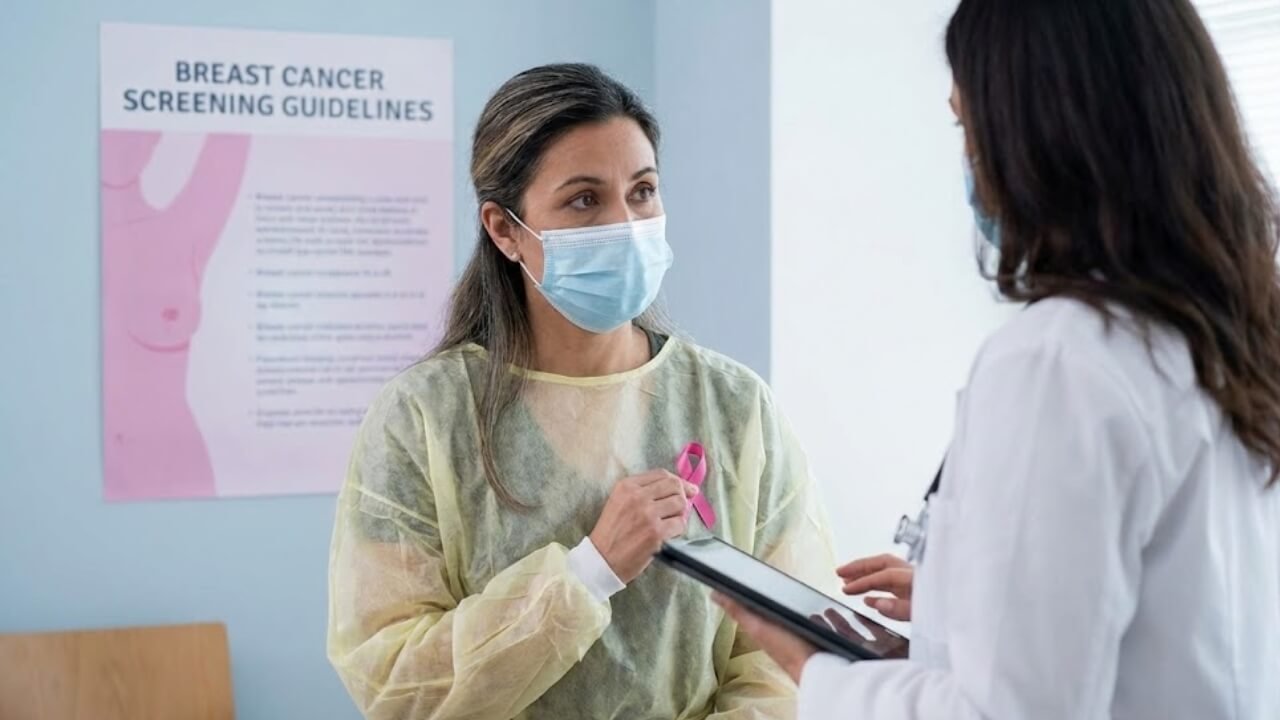
Early Detection Saves Lives
Breast cancer screening detects cancer before symptoms appear, when it’s most treatable. While no screening test is perfect, mammography significantly reduces breast cancer deaths. Understanding when and how to screen empowers you to make informed decisions about your health.
Why Screening Matters
Early Detection Improves Survival:
- Localized breast cancer (caught early, hasn’t spread): 99% 5-year survival rate
- Regional spread (spread to nearby lymph nodes): 86% 5-year survival
- Distant spread (metastatic): 29% 5-year survival
The Goal: Find cancer when it’s small, before it spreads, when treatment is most effective and survival rates highest.
Screening Saves Lives: Regular mammography screening reduces breast cancer deaths by about 20-40%, depending on age and risk level.
Screening Methods
Mammography (The Gold Standard)
What It Is: X-ray examination of breasts to detect lumps, calcifications, or other abnormalities before they can be felt.
Types:
2D Digital Mammography:
- Standard mammogram
- Takes two images of each breast (top-to-bottom and side-to-side)
- Widely available
3D Mammography (Tomosynthesis):
- Takes multiple images from different angles
- Creates 3D reconstruction of breast
- Advantages: Detects 20-65% more invasive cancers, reduces false positives by 15-40%, especially beneficial for dense breasts
- Disadvantages: Slightly higher radiation dose (still very safe), not universally available, may not be covered by insurance
- Increasingly becoming standard of care
How Often: Varies by age and risk level (see guidelines below)
Clinical Breast Exam (CBE)
What It Is: Physical examination of your breasts by healthcare provider, checking for lumps, changes in size/shape, skin changes, nipple discharge.
Effectiveness:
- Finds some cancers not visible on mammogram
- Less effective than mammogram for early detection
- Value is debated—some organizations recommend, others consider optional
How Often: If recommended by your provider, typically annually during well-woman exam.
Breast Self-Examination (BSE)
What It Is: You examine your own breasts monthly, feeling for lumps, changes, or abnormalities.
Current Recommendations:
- Not required but optional for breast self-awareness
- BSE alone does NOT reduce deaths from breast cancer
- Some women find lumps through BSE that are cancer
- Many organizations now recommend “breast self-awareness” over formal monthly exams
Breast Self-Awareness Means:
- Know how your breasts normally look and feel
- Report any changes to your doctor
- Don’t panic about normal lumpiness (many benign changes occur)
- Be aware but don’t obsess
If You Choose to Do BSE:
- Once monthly, 3-5 days after period ends (when breasts least lumpy)
- If postmenopausal, same day each month
- Look in mirror (arms at sides, arms raised, pressing on hips), feel lying down and in shower, use pads of fingers in circular motions covering entire breast and armpit
Ultrasound
What It Is: Uses sound waves to create images of breast tissue.
When Used:
- To evaluate lumps found on mammogram or physical exam
- Supplemental screening for women with dense breasts (may be recommended in addition to mammogram)
- For women who can’t have mammogram (pregnant, very young)
Not Routine: Ultrasound is not a substitute for mammography in average-risk screening.
Breast MRI
What It Is: Magnetic resonance imaging creates detailed images of breast tissue.
When Used:
- High-risk women (BRCA mutations, strong family history, prior chest radiation)
- Problem-solving when mammogram/ultrasound inconclusive
- Evaluating extent of known cancer
- Checking breast implant integrity
Not for Average-Risk Women: MRI is very sensitive but has high false positive rate, leading to unnecessary biopsies. Only recommended as screening for high-risk women.
Screening Guidelines for Average-Risk Women
Multiple organizations have slightly different recommendations. Your healthcare provider will help you determine what’s best for your individual situation.
Age 40-49
American Cancer Society (ACS):
- Optional annual mammography starting at 40
- Discuss benefits and risks with your provider
- Make informed decision based on your preferences
U.S. Preventive Services Task Force (USPSTF):
- Screening in 40s should be individual decision
- Discuss with provider based on your values, risk factors
- Evidence shows benefit but also more false positives in this age group
American College of Obstetricians and Gynecologists (ACOG):
- Annual mammography starting at 40 (or earlier if high-risk)
The Debate: Breast cancer less common in 40s, breast tissue often denser (making mammograms less accurate), more false positives leading to unnecessary anxiety and biopsies. However, screening does save lives in this age group—about 1 death prevented per 1,000 women screened over 10 years.
Bottom Line for Age 40-49:
- If you want to start screening at 40, do it (strongly recommended by most experts)
- Benefits increase as you approach 50
- Screening annually gives best results
Age 50-69 (Strongest Evidence for Benefit)
All Major Organizations Agree:
- Mammography every 1-2 years
- Greatest benefit of screening occurs in this age group
- Breast cancer more common, breast tissue less dense (easier to see on mammogram)
Frequency:
- Annual screening finds cancers slightly smaller/earlier
- Biennial (every 2 years) screening reduces false positives, less radiation exposure, fewer unnecessary biopsies
- Many experts recommend annual screening for best outcomes
Bottom Line for Age 50-69:
- Definitely get screened
- Annual screening preferred by most experts
- At minimum, every 2 years
Age 70 and Older
Recommendations:
- Continue screening as long as overall health is good and life expectancy is 10+ years
- Benefits decrease with age (slower-growing cancers, competing health concerns)
- Discuss with your provider based on your health status
Consider Stopping Screening If:
- Significant health problems that limit life expectancy
- Would not pursue treatment if cancer found
- Screening and treatment would significantly reduce quality of life
Many Women Continue: Many women over 70 are healthy and active. If that’s you, continuing screening makes sense.
Clinical Breast Exam (CBE)
Varies by Organization:
- ACOG: Annually for women 40+
- ACS: Optional, discuss with provider
- USPSTF: Insufficient evidence to recommend for or against
Practical Approach: If you see your provider annually for well-woman exam, CBE takes just a few minutes and may find cancers between mammograms. Low-risk test worth doing.
Screening Guidelines for High-Risk Women
High-Risk Defined:
- BRCA1 or BRCA2 mutation (or first-degree relative with mutation but you’re untested)
- Other genetic mutations (PALB2, TP53, PTEN, CDH1)
- Lifetime risk 20% or higher (calculated by risk assessment tool)
- Chest radiation between ages 10-30 (e.g., for Hodgkin lymphoma)
- Personal history of breast cancer
- Atypical hyperplasia or LCIS on biopsy
Enhanced Screening Protocol
Annual Mammography + Annual Breast MRI:
- Start at age 25-30 (or 10 years before youngest family member’s diagnosis, but not before 25)
- Mammogram and MRI should be 6 months apart (staggered, so you’re screened every 6 months)
- MRI is more sensitive for high-risk women
- Continue throughout life as long as health is good
Clinical Breast Exam:
- Every 6-12 months by provider experienced with high-risk patients
Consider:
- Risk-reducing medications (tamoxifen, raloxifene)
- Prophylactic mastectomy (BRCA carriers)
Coordination:
- See breast specialist or work with high-risk clinic
- Genetic counseling if not already done
Dense Breast Tissue
What It Means: Breasts are composed of fatty tissue (appears dark on mammogram) and dense tissue including glands and connective tissue (appears white). Dense tissue makes it harder to see cancers (which also appear white).
Density Categories:
- Almost entirely fatty
- Scattered fibroglandular density
- Heterogeneously dense (40% of women)
- Extremely dense (10% of women)
Why It Matters:
- Density decreases mammography sensitivity (harder to see cancer)
- Dense tissue itself slightly increases breast cancer risk (4-6 times higher if extremely dense)
If You Have Dense Breasts:
- You’ll be notified after mammogram
- Discuss supplemental screening with your provider
- Options: breast ultrasound, breast MRI (for high-risk), 3D mammography (better for dense breasts)
- Many states require insurance to cover supplemental screening
Note: Breast density decreases with age and after menopause. If you had dense breasts in your 40s, they may be less dense in your 50s-60s.
What to Expect During Mammogram
Scheduling:
- Schedule for week after your period (when breasts least tender)
- Don’t wear deodorant, powder, lotion on breasts or underarms (can look like calcifications on x-ray)
- Wear two-piece outfit (remove top only)
- Bring previous mammogram images if going to new facility
The Procedure:
- Stand in front of machine
- Technologist positions breast on plate
- Clear plastic plate compresses breast (firmly but briefly—10-15 seconds per image)
- Two views of each breast (top-to-bottom and side-to-side)
- Total time: 10-20 minutes
Compression:
- Necessary to flatten breast tissue so x-rays can penetrate evenly
- Spreads tissue so overlapping structures don’t hide abnormalities
- Uncomfortable but usually not painful
- Lasts only seconds for each image
- If very painful, tell technologist—may be able to adjust
After:
- Results usually available within 1-2 weeks
- May hear sooner if everything normal
- Callback for additional imaging doesn’t mean you have cancer (see below)
Understanding Your Results
BI-RADS Categories: Mammograms are reported using standardized system:
BI-RADS 0:
- Incomplete—need additional imaging (ultrasound, additional mammogram views, comparison to previous films)
- Very common, usually nothing serious
BI-RADS 1:
- Negative—no abnormalities found
- Continue routine screening
BI-RADS 2:
- Benign (non-cancerous) findings noted (cysts, calcifications, lymph nodes)
- Continue routine screening
BI-RADS 3:
- Probably benign—needs short-term follow-up (usually 6-month repeat mammogram to confirm stability)
- Less than 2% chance of cancer
BI-RADS 4:
- Suspicious abnormality—biopsy recommended
- Subcategories 4A (low suspicion), 4B (moderate), 4C (high) indicate likelihood of cancer
- Range from 2% to 95% chance of cancer depending on subcategory
BI-RADS 5:
- Highly suggestive of malignancy—biopsy required
- Over 95% chance of cancer
BI-RADS 6:
- Known cancer—applies to mammograms after cancer diagnosis (monitoring treatment)
Getting Called Back (It’s Usually Nothing!)
Callbacks Are Common:
- About 10% of screening mammograms result in callback for additional imaging
- 90-95% of callbacks are FALSE POSITIVES—nothing serious found
Why You Might Be Called Back:
- Need comparison to previous images (not available)
- Overlapping tissue that needs different view
- Dense breast tissue obscuring area
- Benign finding needs better visualization
- True abnormality requiring further evaluation
What Happens:
- Additional mammogram views (spot compression, magnification)
- Often ultrasound to evaluate area
- Radiologist reviews images immediately
- Most women cleared same day
Try Not to Panic: Being called back is very common and usually resolves without biopsy. However, take it seriously and go promptly for additional imaging.
If Biopsy Is Recommended
Types:
- Fine needle aspiration: Thin needle removes cells (rarely used for breast)
- Core needle biopsy: Larger needle removes tissue samples (most common)
- Stereotactic biopsy: Mammogram guides needle
- Ultrasound-guided biopsy: Ultrasound guides needle
- Surgical biopsy: Removes entire lump (rarely needed)
The Procedure:
- Local anesthesia
- Minor discomfort but not painful
- Takes 30-60 minutes
- Small marker clip left inside to mark biopsy site
- Results in 2-5 days
Results:
- Benign (not cancer)—no further action, continue screening
- High-risk lesion—may need surgical removal
- Cancer—refer to surgeon and oncologist
If Cancer Diagnosed: Early detection through screening means smaller cancers, less aggressive treatment, better outcomes. Screening saved your life by finding it early.
Overcoming Barriers to Screening
Common Reasons Women Skip Screening:
- Too busy
- Forgot or kept putting it off
- Fear of results
- Mammograms uncomfortable
- Cost concerns
- No symptoms (“I feel fine”)
- COVID concerns
The Reality:
- Breast cancer has no symptoms in early stages—that’s why screening is necessary
- Mammograms take 15 minutes—schedule it like any important appointment
- Most insurance plans cover annual screening with no copay (preventive care)
- Free or low-cost screening available through local programs if uninsured
- Discomfort lasts seconds and is tolerable
- Early detection dramatically improves outcomes—not screening is much riskier than finding cancer early
Make It Happen:
- Schedule mammogram for same month every year (birthday month, January, etc.)
- Put reminder in phone/calendar
- Schedule for convenient time
- Bring friend for support if anxious
- Remind yourself: 15 minutes could save your life
The Bottom Line
Screening Guidelines Summary:
Age 40-49: Annual mammography (strongly recommended) or start at 40 with shared decision-making with provider
Age 50-69: Annual mammography (preferred) or at least every 2 years
Age 70+: Continue if healthy with 10+ year life expectancy
High-risk: Annual mammography + annual MRI starting age 25-30, staggered 6 months apart
All Ages: Know your breasts, report changes, don’t skip appointments
Key Takeaways:
- Screening saves lives—make it a priority
- Callbacks are common and usually nothing
- Dense breasts may need supplemental screening
- Know your risk and screen accordingly
- Find cancer early when most treatable
You’ve Got This: Screening mammograms are quick, safe, and potentially life-saving. Making and keeping your mammogram appointment is one of the most important things you can do for your health.