

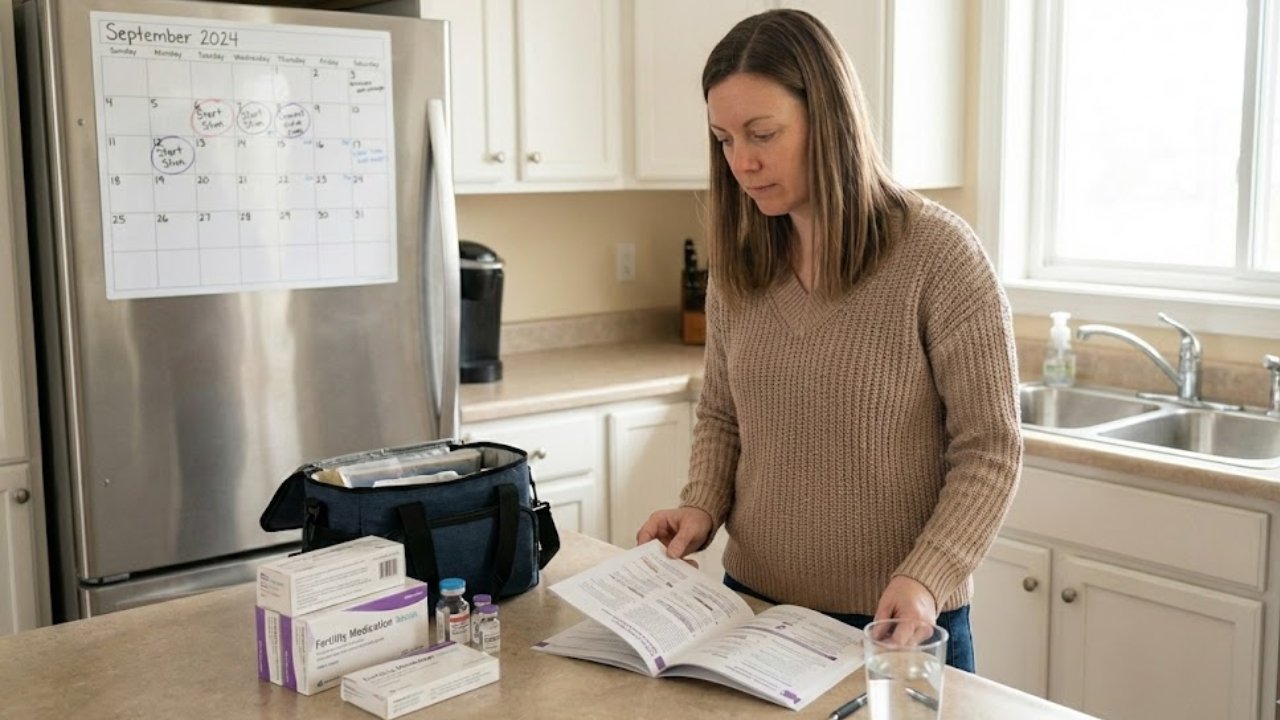
Fertility medications stimulate your ovaries to produce eggs, support ovulation, and prepare your body for pregnancy.
Overview
Fertility drugs are powerful tools:
- Stimulate egg production
- Trigger ovulation
- Prepare uterus for implantation
- Support early pregnancy
- Most are hormones or hormone-related
Used in IUI and IVF cycles.
Most require injections – you’ll learn to give yourself shots.
Ovulation-Inducing Medications
Clomiphene Citrate (Clomid, Serophene)
What it is:
- Oral medication (pills)
- Selective estrogen receptor modulator (SERM)
- Tricks brain into thinking estrogen is low
- Brain responds by producing more FSH
- FSH stimulates follicle growth
Who it’s for:
- Women with irregular ovulation
- PCOS
- Unexplained infertility
- First-line treatment often
- IUI cycles
How to take:
- Days 3-7 or 5-9 of cycle (varies)
- One pill daily for 5 days
- Oral medication (easy!)
Dose:
- Usually start 50mg
- Can increase to 100mg, 150mg if needed
- Higher doses more side effects
Success:
- 80% of women ovulate
- 40-50% get pregnant within 6 cycles (if ovulation was the only problem)
Side effects:
- Hot flashes (very common)
- Mood swings, irritability
- Headaches
- Blurred vision (rare, stop if occurs)
- Abdominal bloating
- Breast tenderness
- Drying cervical mucus (can reduce fertility – ironic!)
Multiple pregnancy risk:
- 5-10% twins
- Less than 1% triplets or more
Monitoring:
- Ultrasound mid-cycle to confirm ovulation
- Check number of follicles
- Blood work for ovulation confirmation
Letrozole (Femara)
What it is:
- Oral medication
- Aromatase inhibitor (originally for breast cancer)
- Reduces estrogen production
- Brain responds by producing FSH
- Stimulates ovulation
Who it’s for:
- PCOS (often preferred over Clomid)
- Poor response to Clomid
- Unexplained infertility
- IUI cycles
Advantages over Clomid:
- Doesn’t thin uterine lining
- Doesn’t dry cervical mucus
- Shorter half-life (out of system faster)
- May have better success rates, especially with PCOS
How to take:
- Days 3-7 of cycle typically
- One pill daily for 5 days
- Oral medication
Dose:
- Usually 2.5mg to 7.5mg daily
Side effects:
- Fewer than Clomid generally
- Fatigue
- Dizziness
- Headaches
- Hot flashes (less common than Clomid)
Injectable Gonadotropins (Stimulation Medications)
These are the “big guns” – powerful medications for IVF.
FSH (Follicle-Stimulating Hormone)
Brand names:
- Gonal-F (follitropin alfa)
- Follistim (follitropin beta)
- Bravelle (urofollitropin)
What it is:
- Hormone that directly stimulates follicles
- Causes multiple eggs to develop
- Subcutaneous injection (small needle, just under skin)
- Daily injections
Who it’s for:
- IVF cycles
- IUI with injectables
- Poor response to oral medications
How to take:
- Daily injections starting Day 2-3 of cycle
- Usually 10-14 days
- Dosage individualized (often 150-300 IU daily)
- Pen injector devices (easier than drawing up)
Monitoring:
- Frequent ultrasounds (every 2-3 days)
- Blood estradiol levels
- Adjust doses based on response
Response varies:
- Some women very sensitive (need low doses)
- Others need high doses
- Can’t predict until you try
LH (Luteinizing Hormone)
Brand names:
- Luveris
- Menopur (contains FSH + LH)
What it is:
- Supports FSH in follicle development
- Some women need both FSH and LH
- Also subcutaneous injection
Who needs it:
- Women over 35 sometimes benefit
- Poor response to FSH alone
- Suppressed LH from other medications
Often combined with FSH in same protocol.
Human Menopausal Gonadotropin (hMG)
Brand name:
- Menopur
What it is:
- Contains both FSH and LH
- Purified from postmenopausal women’s urine
- Subcutaneous or intramuscular injection
Who it’s for:
- IVF cycles
- Women who need both FSH and LH
- Alternative to separate FSH + LH
Side effects of all gonadotropins:
- Injection site reactions (redness, bruising)
- Bloating and abdominal discomfort
- Breast tenderness
- Mood swings
- Headaches
- Fatigue
- Ovarian hyperstimulation syndrome (OHSS) – serious but rare
Multiple pregnancy risk:
- High with IUI + injectables (can be 20-30% multiples)
- Controlled with IVF (embryo number controlled)
Preventing Premature Ovulation
Problem: Stimulation medications grow follicles, but body may release eggs too early (before retrieval).
Solution: Suppress natural LH surge.
GnRH Antagonist
Brand name:
- Cetrotide (cetrorelix)
- Ganirelix
What it is:
- Blocks GnRH receptors
- Prevents LH surge
- Prevents premature ovulation
- Subcutaneous injection
When started:
- Mid-cycle (Day 5-6 of stimulation typically)
- When follicles reach certain size
- Daily until trigger shot
Advantages:
- Quick onset
- Short protocol (fewer total injection days)
- Lower OHSS risk
Side effects:
- Injection site reactions
- Headache
- Nausea
GnRH Agonist
Brand names:
- Lupron (leuprolide)
- Decapeptyl
- Gonapeptyl
What it is:
- Initially stimulates then suppresses pituitary
- Prevents premature ovulation
- Daily or single injection
Protocols:
- Long protocol: Started before stim cycle (suppression first)
- Short protocol: Started with stimulation
- Flare protocol: Uses initial stimulation effect
Advantages:
- Been around longer (well-studied)
- Flexible protocols
Disadvantages:
- Longer treatment
- More menopausal side effects (if long protocol)
- Slightly higher OHSS risk
Side effects:
- Hot flashes
- Headaches
- Mood changes
- Vaginal dryness
- Fatigue
Your doctor chooses based on your specific situation.
Trigger Shot (Final Maturation)
hCG (Human Chorionic Gonadotropin)
Brand names:
- Pregnyl
- Ovidrel
- Novarel
What it is:
- Mimics LH surge
- Triggers final egg maturation
- Causes ovulation 36-40 hours later
When given:
- When follicles mature (18-20mm)
- Precise timing critical
- Usually evening (9pm-midnight)
For IUI:
- Inseminations timed based on trigger
For IVF:
- Egg retrieval scheduled 36 hours after
- Must be retrieved before ovulation
TIMING IS EVERYTHING!
- Set multiple alarms
- Double-check time
- Have backup plan
- Missing it means cycle canceled
Side effects:
- Breast tenderness
- Bloating
- Mood changes
- Increases OHSS risk (gives “pregnant” signal to ovaries)
Luteal Phase Support
After ovulation/retrieval, progesterone needed to support implantation and early pregnancy.
Progesterone
Forms:
- Vaginal suppositories (Cyclogest, Endometrin, Crinone gel) – most common
- Injections (intramuscular) – oil-based, painful
- Oral capsules – less effective
What it does:
- Prepares uterine lining for implantation
- Supports early pregnancy
- Prevents menstruation
When started:
- Day after IUI
- Day of or after egg retrieval (IVF)
- Continued through pregnancy test
If pregnant:
- Continue 8-12 weeks into pregnancy
- Until placenta takes over production
Side effects:
- Vaginal discharge/irritation (suppositories)
- Breast tenderness
- Fatigue
- Bloating
- Mood changes
- Symptoms mimic early pregnancy (confusing during two-week wait!)
Intramuscular injections:
- Painful
- Bruising
- Lumps at injection sites
- Heating pad before helps
- Massage after helps
Additional Medications
Aspirin (Low-Dose)
What it is:
- “Baby aspirin” (81mg)
- Blood thinner
Who it’s for:
- Some doctors recommend routinely
- Recurrent miscarriage
- Clotting disorders
- May improve blood flow to uterus
Controversial – not universally recommended.
Enoxaparin / Innohep (Low Molecular Weight Heparin)
What it is:
- Injectable blood thinner
- Prevents blood clots
Who it’s for:
- Clotting disorders
- Recurrent miscarriage with clotting issues
- History of blood clots
- Some cases of repeated implantation failure
Subcutaneous injection:
- Daily throughout pregnancy if needed
Side effects:
- Bruising at injection sites
- Bleeding risk
Antibiotics
Usually given:
- With egg retrieval (prevent infection)
- Short course (few days)
- Doxycycline common
Estrogen (Estradiol)
Forms:
- Pills, patches, or injections
Uses:
- Build uterine lining
- Frozen embryo transfer cycles
- Support early pregnancy sometimes
Prenatal Vitamins
Essential throughout:
- Start before conception
- Folic acid most important (prevents neural tube defects)
- 400-800 mcg daily minimum
- Take throughout treatment and pregnancy
DHEA (Dehydroepiandrosterone)
What it is:
- Androgen supplement
- Over-the-counter
Who it’s for:
- Low ovarian reserve
- Advanced maternal age
- Poor egg quality
Theory:
- Improves ovarian environment
- May improve egg quality and quantity
- Takes 3+ months to see effect
Evidence:
- Some studies show benefit
- Not definitive
- Discuss with doctor
Dose:
- 75mg daily typically
Managing Medications
Organization Is Key
You’ll have multiple medications:
- Different timing
- Different doses
- Different injection techniques
- Easy to get confused
Tips:
- Use calendar or app
- Set phone alarms
- Checklist for each day
- Organize supplies in one place
- Label everything clearly
Injection Techniques
Subcutaneous (most fertility injections):
- Just under skin
- Abdomen (2 inches from belly button) or thigh
- Small needle (less scary than it sounds)
- Pinch skin, insert at 45-90 degree angle
- Quick and relatively painless
Tips:
- Ice area first (numbs)
- Let alcohol dry completely
- Quick insertion (don’t hesitate)
- Rotate injection sites
- Relax muscles
Intramuscular (progesterone sometimes):
- Deep into muscle
- Upper outer quadrant of buttock
- Longer, larger needle
- More uncomfortable
- Heat pad before, massage after
Clinic teaches you – they’ll practice with you.
Partner can help – many partners give injections.
Storage
Most require refrigeration:
- Check each medication
- Don’t freeze
- Travel with cooler if needed
- Room temperature okay briefly
Cost Management
Fertility meds are expensive:
- Check insurance coverage first
- Specialty pharmacy required often
- Shop around (prices vary!)
- Discount programs available:
- Compassionate Care programs from manufacturers
- Fertility pharmacy discount programs
- Compare multiple pharmacies
- Buy exactly what you need (dose adjustments common)
- Save leftover for future cycle or donate
Side Effects Management
Common Side Effects
Bloating and abdominal discomfort:
- Drink lots of water
- Eat smaller meals
- Avoid salty foods
- Rest
- Heating pad
Mood swings:
- Expect them
- Warn partner
- Be gentle with yourself
- Temporary
Headaches:
- Stay hydrated
- Tylenol okay
- Rest
Breast tenderness:
- Supportive bra
- Usually temporary
Fatigue:
- Listen to your body
- Rest when needed
- Not the time to push yourself
Injection site reactions:
- Rotate sites
- Ice before, heat after
- Arnica gel for bruising
- Massage gently
When to Call Doctor
Call immediately if:
- Severe abdominal pain
- Severe bloating
- Rapid weight gain (>2 pounds per day)
- Difficulty breathing
- Decreased urination
- Severe nausea/vomiting
These may indicate OHSS – serious complication requiring monitoring or treatment.
Emergency Contact: 026965055
Remember
Fertility medications are powerful tools that help millions achieve pregnancy.
Side effects are temporary. The goal is permanent.
You’re stronger than you think. You can do this.
Injections become routine quickly. First one is hardest.
Stay organized. Ask for help. You’ve got this.